All Things Reversed: Making Sense of the Upside-Down Tarot Card
Unlock the secrets of reversed tarot cards!
In this episode of the Every Day Tarot Podcast, I dive deep into the meaning and interpretation of reversal cards, offering insights for both beginners and seasoned readers.
Whether you're curious about how to read them or want to enhance your tarot practice, this episode is packed with valuable tips and techniques.
How I Read Reversed Tarot Cards: My Philosophy, Methods, and a Real Example
I get this question a lot: how do I read reversed tarot cards, and do I even need to?
In this episode, I walk through my personal approach, share a few different reversal methods, and explain how I think about reversals depending on the deck. I also use a real card example so you can see how this works in practice.
If you’ve ever felt unsure about whether to read reversals, this is for you. I break it down in a way that is practical, intuitive, and flexible - because I don’t think tarot has to be rigid to be meaningful.
My Personal Philosophy on Reversed Cards
My starting point is simple: I generally do read reversals, but I don’t treat every deck the same way.
That matters more than people sometimes realize. A traditional tarot deck usually gives me enough symbolism to work with in both upright and reversed positions. But with some Oracle decks, I don’t always feel that same logic applies. If a deck is built around plants, numbers, or symbols that don’t have an obvious “opposite,” I may not read reversals at all.
For example, I mention decks where the imagery is horizontal or where the card system already has its own built-in reversal logic. In those cases, I want to respect the structure of the deck instead of forcing a method onto it. That’s a big part of my approach: I try to let the deck tell me how it wants to be read.
That said, I’m very open to reversals as a reader. I know some readers never use them, some always do, and some only do in certain situations. I think all of those approaches can be valid. What matters most is whether the method helps me arrive at a clearer, more useful message.
What Reversed Tarot Cards Can Mean
There’s a common assumption that reversed cards just mean the opposite of upright cards. Sometimes that works. But in my experience, that’s too narrow to be the whole story. I talk through several ways reversals can function:
1. The visual meaning
One of the simplest methods is to literally look at the card upside down and ask: what changes visually?
Sometimes the reversed image feels unsettled, blocked, or upside down in a way that makes the meaning obvious. Other times, the reversal changes the emphasis in a surprising way. A card like the Hanged Man, for instance, can feel very different when reversed because the image itself tells a different story.
2. The internal meaning.
Another useful approach is to ask whether the reversed card points to something internal rather than external. If an upright card is about what’s happening in the world around you, the reversed version might be about what’s happening inside you - your mindset, your fears, your reactions, or your private tension. This is especially helpful when a card feels emotionally true but not literally true.
3. Too much or too little
This is one of my favorite ways to read reversals because it feels nuanced without becoming vague.
Instead of saying the card is the opposite, I ask whether the energy is showing up as too much of the card’s theme or too little of it.
That distinction matters. For example, too much inner strength can become pride or self-protection. Too little inner strength can become self-doubt or collapse.
4. A blockage or interruption
Sometimes the reversal says the energy is present, but blocked. That can mean something is getting in the way of the card’s message expressing itself cleanly. It might be fear, resistance, old conditioning, or even a message from another person that you’ve internalized. I like this option because it keeps the reading active. A reversal isn’t always a hard “no” - sometimes it’s a “not yet” or “something’s in the way.”
My Favorite Traditional Approach: Read the Energy, Not Just the Position
One of the books I discuss, The Upside Down Tarot by Joan Bunning, offers a method I find especially interesting.
Instead of treating reversals as a simple opposite, it treats them as a different phase of energy.
That idea is really useful to me. The book frames card energy like a curve. Upright energy is often seen as fully present, developed, or active. Reversed energy might be:
in an early phase
in a late phase
or nearly absent
That gives me a lot more flexibility. It lets me ask better questions. Is this energy just beginning? Is it fading out? Has it already passed? Is the card pointing to something that’s complete, incomplete, hidden, or still forming?
That way of reading reversals keeps me from forcing a one-size-fits-all interpretation. It also keeps me in dialogue with the reading instead of rushing to a conclusion.
I also appreciate that this method reminds me to stay intuitive. A framework is useful, but it shouldn’t replace my own discernment.
If I’m reading for myself or someone else, I still need to ask: what feels true here, right now?
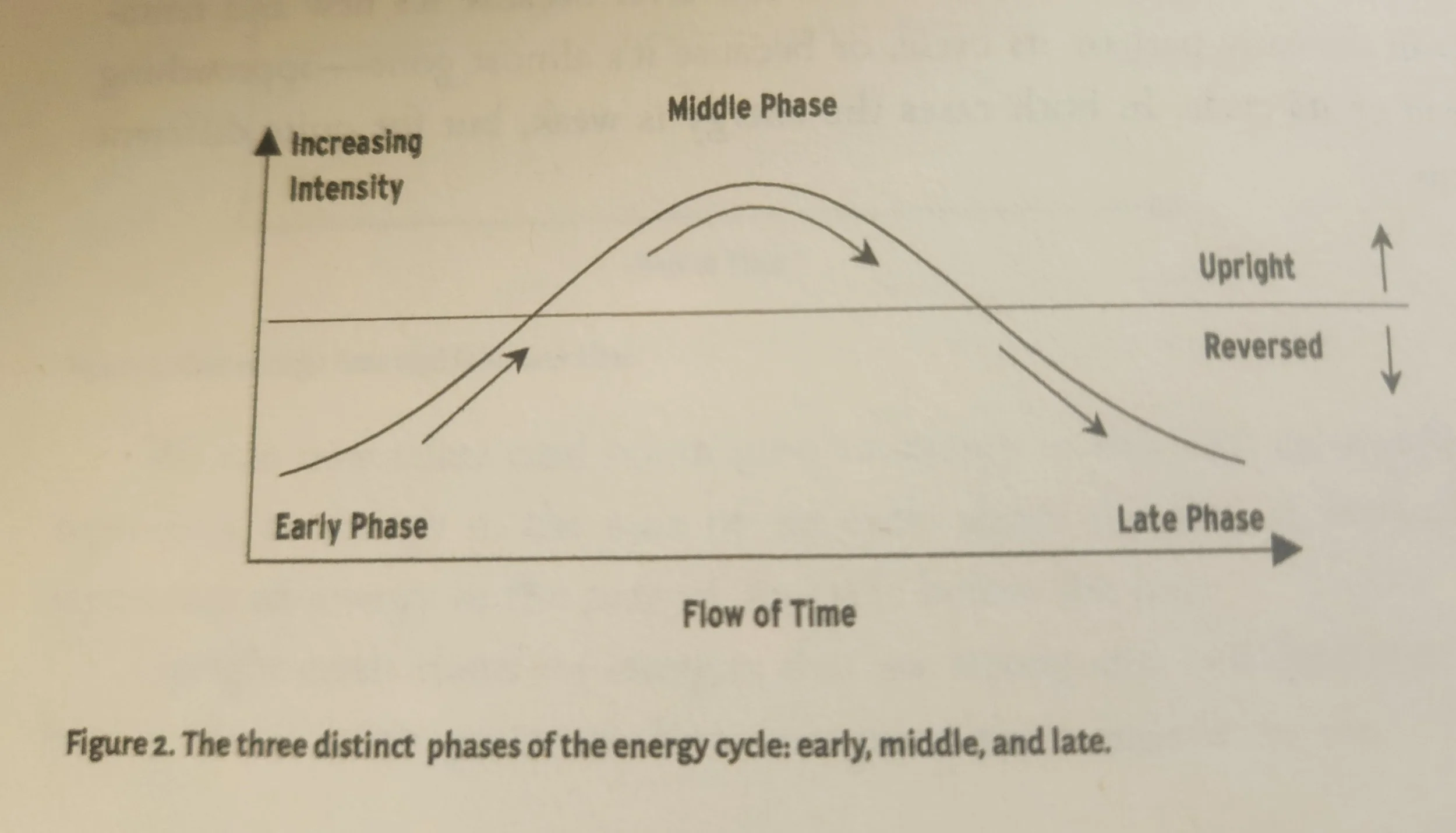
Diagram showing three phases of tarot energy in reversal reading - early, peak, and late or absent]
A Real Example: The Seven of Cups Reversed
At the end of the episode, I pull the Seven of Cups reversed from the Snag Tarot deck. I think it’s a great example of how flexible reversal reading can be.
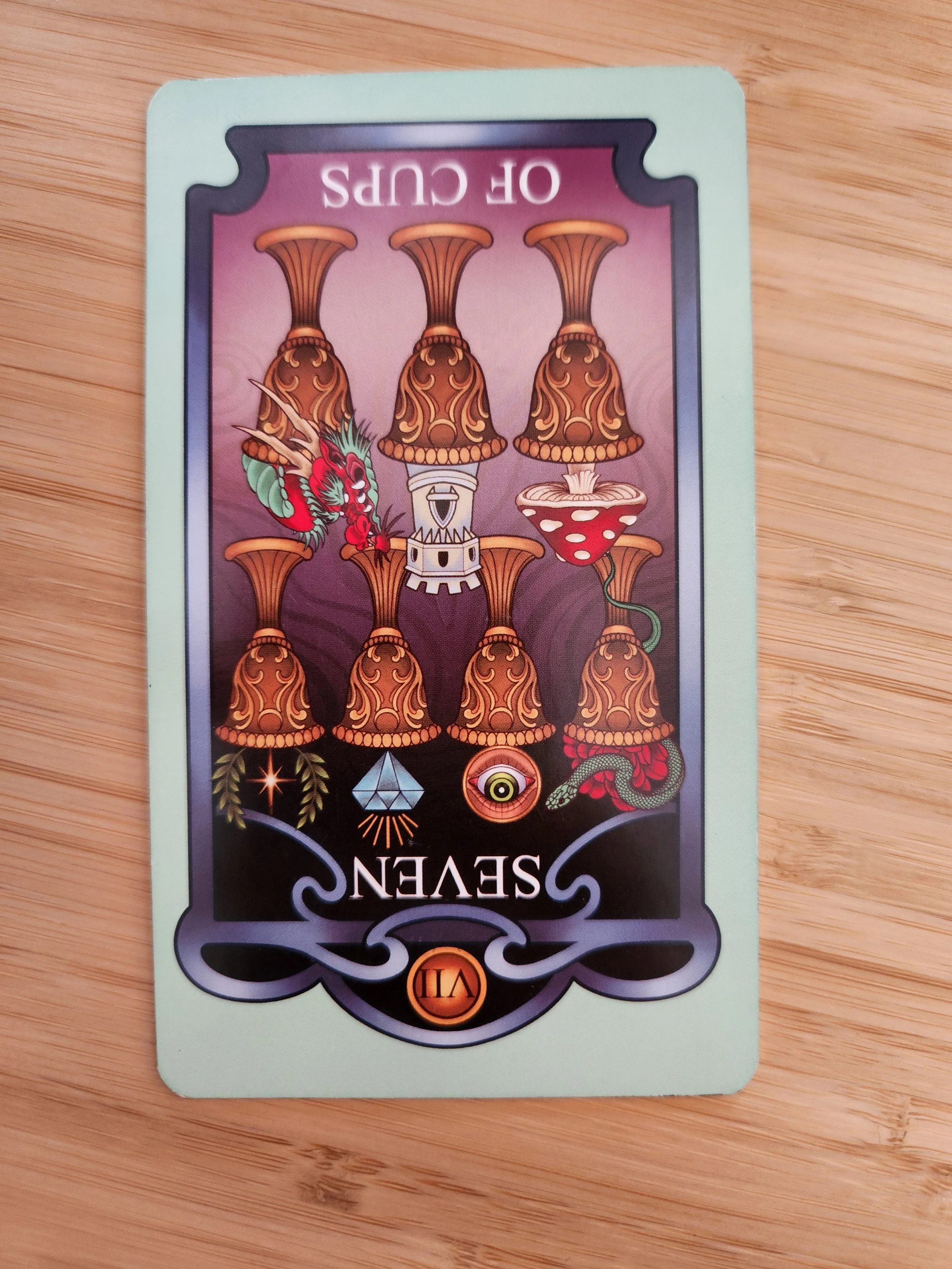
Upright, the Seven of Cups is often about illusion, fantasy, overwhelm, and too many options. It can point to a moment where everything feels possible, but not everything is grounded in reality. In this deck, the imagery shows multiple cups with different symbols inside them, which makes that meaning very clear.
Reversed, I don’t read it as just the opposite. Instead, I ask what the reversal is doing. For me, this card suggests that reversal reading itself doesn’t have just one correct answer. There are multiple ways to interpret reversals, and none of them have to cancel out the others. In that sense, the card becomes a little meta - it reflects the idea that tarot offers options, not rigid rules.
I also think the reversed Seven of Cups can be understood through the “too much or too little” lens. Too many options can create confusion. Too few options can also create confusion. In both cases, the message is the same: clarity is needed.
That’s why I like reversals when they’re read well. They don’t just complicate a reading. They deepen it.
How I Decide Whether to Read a Reversal
This is the part that matters most in practice. I don’t think I need to read reversals just because I own a deck. I read them when they help me get closer to the truth of the reading. That means I’m paying attention to:
the deck itself
the symbolism in the card
the question being asked
the spread position
and my intuition
If a deck already has a strong symbolic system, reversals often add depth. If a deck feels more intuitive, more abstract, or more image-based, I may read them differently - or not at all. I also don’t think you need to force reversals if you’re new to tarot. You can absolutely learn as you go.
Key takeaways:
Understanding the significance of reversed cards in tarot readings.
Different methods for interpreting reversals.
How reversals can add depth to your readings.
References:
Deck used this episode: Snag Tarot deck by founder Brie and art by Sophie
Books referenced:
Support the Podcast:
If you loved the episode and want more, head over to Patreon right now to check out my exclusive tarot draw, click the Patreon link and join us for the rest of the reading.
If you love the show, the best way to support it for free is by listening daily, leaving a review, and subscribing or following in your favorite podcast app.
Join my newsletter list to get my Hallowed High Priestess Tarot Spread
If you’d like to be a guest on the show, fill out my guest inquiry here.